Does Your Business Website Design Actually Build Trust?
Here's What Google (and Your Customers) Look For in 2026
Does Your Business Website Design Actually Build Trust? Here’s What Google (and Your Customers) Look For in 2026
Your website has about three seconds to answer one question: can I trust this business?
That decision happens before a visitor reads a single word. It happens through design: through the signals your site sends about who you are and whether you’re worth their time.
In 2026, trust is not about looking expensive or trendy. It’s about looking intentional. And both your customers and Google know the difference.
Why Design Determines Trust
Most businesses think trust comes from testimonials or case studies. Those help. But visitors decide whether to read them based on something else entirely: whether your site feels reliable.
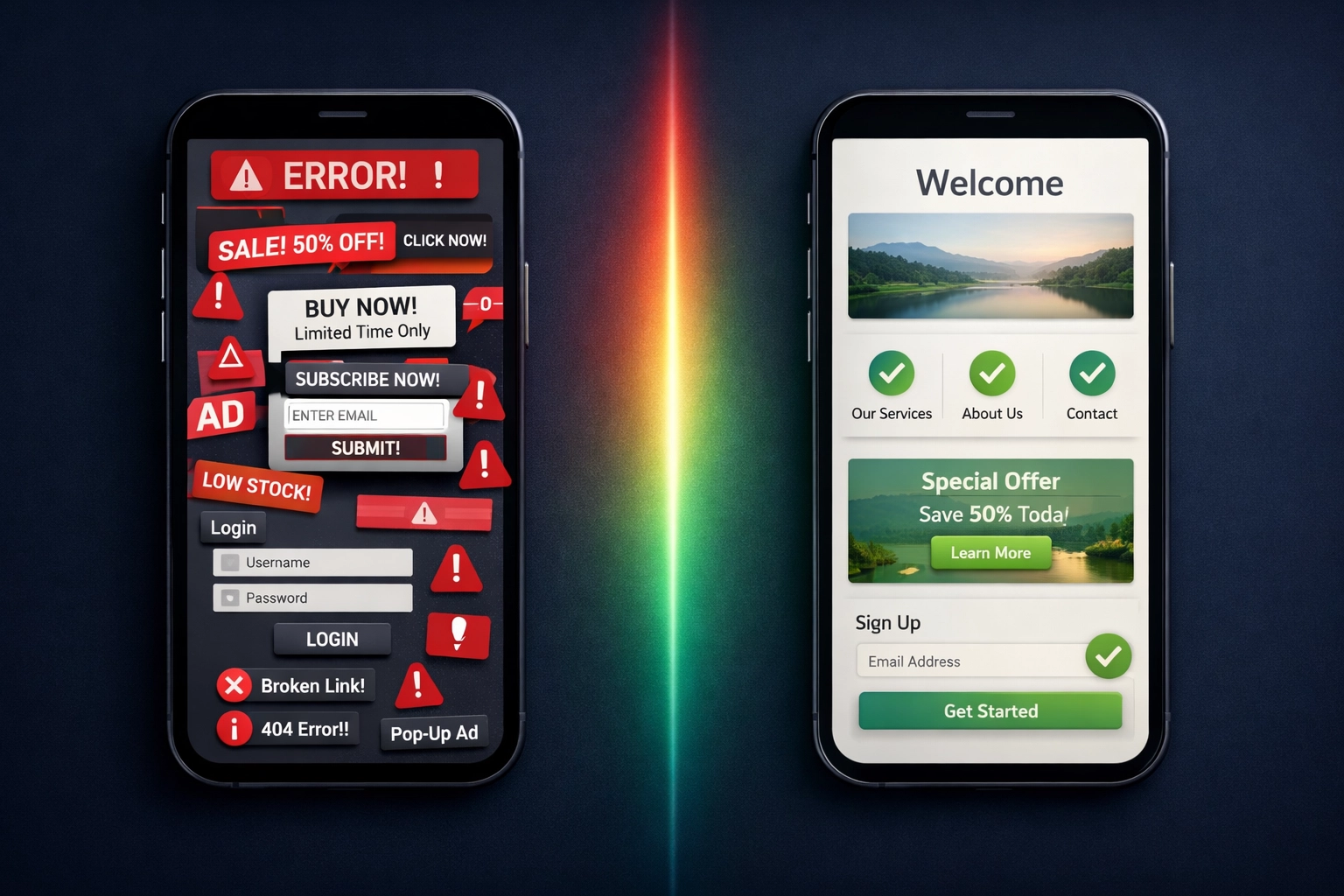
This happens through subtle signals. A confusing layout. Slow loading times. Text that’s hard to read. Navigation that doesn’t make sense.
None of these are dealbreakers on their own. Together, they create doubt. And doubt sends people elsewhere.
The opposite is also true. Sites that prioritize clarity, speed, and purpose make visitors feel confident: even if they can’t articulate why.

What Your Customers Actually Notice
Customers don’t analyze websites. They react to them. And their reactions are shaped by a few key factors.
Content Comes First
Design exists to serve content: not the other way around. Sites that prioritize what users need to know, organized in a way that makes sense, feel trustworthy by default.
This means scannable hierarchy. Readable typography. Clear pathways to what matters most.
When content is buried beneath animations or scattered across unclear sections, visitors assume you have something to hide. Or worse: that you don’t know what you’re doing.
Authenticity Beats Flash
Stock photos of people in suits shaking hands don’t build trust. Neither do over-designed graphics that scream “template.”
Real photography paired with thoughtful design elements proves your business is genuine. It shows personality without sacrificing professionalism.
The same applies to copy. Transparent language: explaining what you do, how you do it, and why it matters: resonates more than vague promises or marketing speak.
Trust Happens in the Details
Micro-interactions matter more than most businesses realize. Buttons that respond when clicked. Forms that validate input clearly. Navigation that behaves predictably.
These details make a site feel alive and responsive. They signal care. And care signals trust.
The inverse is equally true. Broken links, slow responses, and clunky interactions create friction. Friction creates doubt.
Data Privacy Is Now a Design Element
In 2026, users expect transparency about how their data is used. This includes clear consent flows, understandable privacy policies, and visible explanations when AI agents are involved.
This is called Trust UX. It’s not optional anymore. Sites that hide data practices or make privacy policies deliberately confusing lose credibility fast.
What Google Rewards (And Why It Aligns with Customer Expectations)
Here’s the interesting part: Google’s ranking algorithm now prioritizes the same things customers value. The gap between user experience and SEO has nearly disappeared.
Performance Is Non-Negotiable
Page speed is a ranking factor. It’s also a conversion factor. And a trust factor.
Sites that load slowly signal poor quality. Users leave. Google notices. Rankings drop.
Modern design treats performance as a core architectural requirement: not something you optimize later. Fast sites rank higher and convert better.
Accessibility Equals Credibility
Google rewards sites that are accessible to everyone. This means clean code, semantic HTML, and WCAG compliance built in from the start.
Accessible sites also happen to be easier for search engines to crawl and understand. Proper heading structures, alt text, and clear navigation help both users and algorithms.
In 2026, accessibility is becoming SEO 2.0. It’s how AI discovers and recommends your site. Skip it, and you’re invisible.
Visual Hierarchy Signals Authority
Typography matters. Not because it looks good: but because it guides attention and creates structure.
Refined serif fonts for headings can signal editorial polish. Clear type hierarchy helps users scan and comprehend quickly. Strong visual systems build authority without saying a word.
Google measures how users interact with your site. Bounce rates. Time on page. Click depth. Sites with clear visual hierarchy keep users engaged longer: which tells Google your content is valuable.
Where Trust and Rankings Intersect
The overlap between customer trust and Google rankings is no longer coincidental. Both are measuring the same thing: quality.
A site that loads fast, looks intentional, and guides users clearly performs well on both fronts. Customers stay longer. Google ranks it higher.
The opposite creates a vicious cycle. Poor design drives users away. High bounce rates signal low quality to Google. Rankings drop. Fewer people find you. The problem compounds.
This is why treating trust as a design principle: not a marketing tactic: matters. It’s foundational. Everything else builds on it.

What This Means for Your Business
Most businesses approach website design backwards. They focus on aesthetics first, functionality second, and trust as an afterthought.
The businesses that win in 2026 reverse this order. They start with trust: building sites that are fast, clear, accessible, and honest from day one.
This doesn’t mean boring design. It means intentional design. Every element serves a purpose. Nothing exists just to look impressive.
The Trust Checklist
Here’s what your site needs to build trust with both customers and Google:
- Clear visual hierarchy that guides attention naturally
- Fast loading times across all devices and connections
- Accessible design that works for everyone
- Real content that explains what you do without hiding behind jargon
- Transparent data practices with understandable privacy policies
- Responsive interactions that make the site feel alive
- Authentic imagery that reflects your actual business
- Clean code that search engines can crawl efficiently
If your site lacks any of these, you’re not just losing customers. You’re losing rankings. And momentum.
Trust Is Not Optional Anymore
The web has matured. Users have higher expectations. Google’s algorithm reflects those expectations.
Sites that feel trustworthy: through design, performance, and clarity: win on every metric that matters. Traffic. Conversions. Rankings. Growth.
The businesses that understand this build trust into every design decision from the start. They don’t bolt it on later. They don’t treat it as a marketing add-on.
They recognize what customers and Google already know: trust is not a feature. It’s the foundation.
If your site doesn’t build trust within three seconds, you’re already behind. The question is what you do about it.